Showing posts with label Yarmouth. Show all posts

Monday, January 2, 2012

Many local sailors were held in Dartmoor prison during the War of 1812

My focus today is not on a typical old photo from the 19th century. I’ve chosen a foreboding and somewhat creepy image because it points to an important historical theme for the new year. Christina White, the savvy Director of the Freeport Historical Society, recently reminded me that 2012 will usher in the bicentennial of the War of 1812. For those of you can’t imagine why anyone would want to commemorate one of America’s most forgettable wars, pay attention, especially if you live in a seacoast town.

Coastal towns from Portsmouth to Eastport all experienced an economic boom between 1795 and 1805. With shipbuilding on the rise and a growing demand for American agricultural products, the size of the nation’s merchant marine doubled between 1802 and 1810. You can still see this wealth displayed in the elegant Federal style mansions along the main streets of towns like Wiscasset and Kennebunkport. While European countries were embroiled in the bloody Napoleonic wars, American sea captains cheerfully traded with both sides. This rosy situation all changed abruptly when the British imposed an embargo against trade with France and her allies. To enforce that blockade, the Royal Navy needed 140,000 sailors in a hurry. One quick solution was to seize sailors off American ships. This “impressment” of sailors became one of the causes of the War of 1812 and certainly posed a major threat to local sailors.

Dartmoor Prison was a gloomy place high on a windswept hill.

Motivated by these and other grievances, President Madison led the country into war with England in June 1812. Although the United States was very ill prepared, the English forces were completely bogged down in their struggle with Napoleon. This created a window of opportunity for local sailors to become “privateers”. In effect they were state-sponsored pirates who could use their own vessels to seize British merchant ships. These “independent contractors” (as they are now euphemistically called) were motivated by more than patriotism. They were granted the right to auction off the cargoes of their captured prizes at war-inflated prices and split the profits with their crew members.

Given the fact that in the first four months of the war, American privateers captured 219 British merchant vessels, it is not surprising that young men from towns like Freeport and Yarmouth eagerly signed up for voyages on privateers like the Dash. Unfortunately the job was also very dangerous, especially after Napoleon was captured in 1814 and the British navy was able to throw its might against the Americans. So many American sailors were captured that it was no longer feasible to keep them in the rotting old ships that the English used as military prisons. One survivor of these so-called “hulks” was Freeport’s Enos Soule whose vessel was captured by a British frigate. Although Enos survived and later went on to found the Soule Brothers shipyard in South Freeport, his brother Thomas never fully recovered from his time in Dartmoor. The prison claimed another victim when Thomas committed suicide in 1824, very likely from the effects of post traumatic stress.
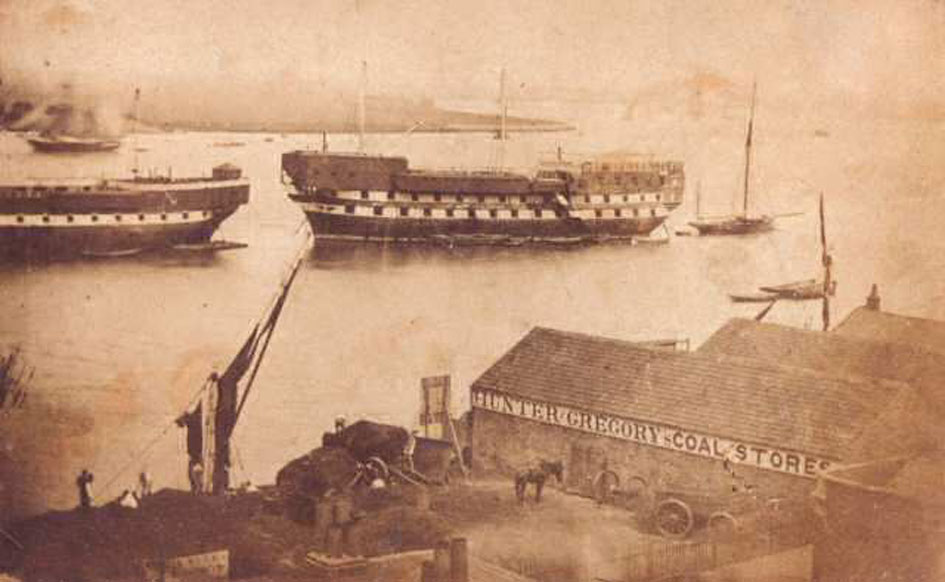
Old warships ("hulks") became floating prisons.

After a mass escape of prisoners from one of the hulks, the British authorities transferred their American captives to a new high security prison called Dartmoor. Conditions at this place were brutal for the 6500 American sailors and soldiers who were kept there during the War of 1812. Most of them were put to work in stone quarries or they were forced to use the stone to construct additional facilities such as a prison chapel.

The historian William Rowe tells us that at least seven privateers operated out of Yarmouth during the War of 1812, including the schooner Lucy that carried 26 men and one cannon. On January 13, 1814 the Lucy was captured after a nine hour chase by a British warship, the Billerton. Perez Drinkwater, the First Lieutenant on the Lucy, wrote three remarkable letters to family members about his experiences at Dartmoor. After the Billerton returned to her home port of Portsmouth, England, Drinkwater and the other American sailors were temporarily held in one of the prison hulks anchored in the harbor.

He recorded that they spent a week in the old hulk before being forced to march through a snowstorm to Dartmoor prison. Perched on a windswept and rocky moor, the prison was located 1700 feet above sea level where it was exposed to year round blasts of rain or snow. Perez described the starvation rations of black bread and beef tea that they received once a day. He also railed against the cruelty of the guards and the nasty reality of being covered with lice (“creepers”).

In October 1814 he wrote to his wife to tell her that he was concerned about how she was getting along. He told her to seek help from a Yarmouth man named Rotheus who was holding some of Perez’s money. “For I can be no help to you at present, but I hope when I get out of this place to make it up to you.” Just days before his release in April 1815, he described a notorious massacre that occurred when the drunken British commandant of Dartmoor ordered his troops to fire on the American prisoners who were crowded together in the prison yard. Although Perez was unharmed, two members of the Lucy crew were shot, one of them fatally. On a lighter but peculiar note, he told his wife that he was shipping home his filthy bedding. Knowing that it was infested with lice, he advised her not to bring it in the house for a while.

As we move into the bicentennial of the War of 1812, I hope that the stories of local heroes like Enos Soule and Perez Drinkwater will bring the war home and make it worth remembering.

Prisoners like Enos and Thomas Soule were forced to quarry the stones to build St. Michael's church at Dartmoor.

Friday, December 9, 2011

Yarmouth’s Community Music Center had a peg-leg ghost and a bomb shelter when I bought the place.

 My focus today is on a Yarmouth landmark, the sea captain’s mansion built by Sylvanus C. Blanchard in 1856. Now called “317 Main Street,” the historic house has been transformed into a cultural crossroads featuring art exhibits, music lessons and concerts. Over the years, the mansion has also served as a boarding house, a lumber yard, a bomb shelter and my wife’s yarn store called, “Martha Hall.” When we purchased the house in1979, she was looking for a great business location while I was chasing stories of ghosts and fascinated by the rooftop “widow’s walk.” As usual her judgment was considerably more astute than mine.

 Just as we were signing the papers to buy the building, the former owner’s wife blurted out that the place was haunted. Over her husband’s protests, she insisted that we would see strange lights and hear a peg-legged sea captain thumping around at night. Despite the many eerie noises in the old house, I soon learned that neither of the two sea captains who lived there had lost any limbs nor had they expired in the building. If you look closely at today’s photograph, you will see the house as it appeared in the 1880’s. Based on another photo that I have seen, the gentleman in the top hat is almost certainly the owner, Captain Eben York.
 
 By the time he retired and purchased the house in 1881, Eben York had commanded some of the Blanchard family’s largest ships. The managing partner of that family-owned shipping business was S.C. Blanchard, the captain who built the house in 1856. Like many Yarmouth mariners, Captain Blanchard had ridden the great wave of prosperity that flowed into Yarmouth before the Civil War. Blanchard ships carried goods like cotton and guano to Europe and hides from South America to New England’s shoe factories. It is very likely that the leather trade brought S.C. Blanchard into contact with the wealthy Portland traders, Andrew and Samuel Spring. In 1855 they hired the talented Portland architect Charles A. Alexander to design their adjacent homes on Danforth Street. Highly regarded for his use of the popular new Italianate style, Charles Alexander’s commissions included the Chestnut Street Church that is now the trendy Portland restaurant, “Grace.”

 In 1856 Captain Blanchard followed the example of the Springs and asked Charles Alexander to design a stylish house that is now 317 Main Street. With marble fireplaces, plaster cupids on the ceiling and a two story outhouse, the elegant home also served as Captain Blanchard’s office and made a bold public statement about his wealth, power and social status. Within two years Blanchard was elected to the state legislature where he offered a dubious proposal to send emancipated slaves back to Africa in Blanchard-built ships. During the Civil War Blanchard sold the house and moved to Boston. Returning when shipbuilding revived in the late 1870’s, he ordered up a new mansion (now 261 Main St.). He had barely occupied that place when financial disaster struck. Running from his creditors, he died in 1888 in a hotel in Richmond, Virginia.

 Although I wasn’t terribly surprised when the handicapped ghosts failed to appear in the old house, I confess that I was a true believer in the idea of a widow’s walk. Somewhere along the way I had heard that the towers and cupolas on sea captains’ homes were designed to give their wives a spyglass view of the sea. From this perch a woman would faithfully watch for her husband’s ship to come sailing home. To test this romantic notion, I grabbed my old brass telescope and clambered up the hidden stairway to Captain Blanchard’s cupola. Alas, I quickly discovered that neither the river nor any patch of Casco Bay was ever visible from the house. With nothing but Wescustogo Hill and Bradbury Mountain to show for my effort, I reluctantly accepted the fact that cupolas on Italianate homes are just another stylistic feature like overhanging roofs, arched windows and bold roof brackets.

 I loved living in that house, in part because I kept stumbling across the traces of those who had been there before me. For example there was an Irish maid who lived in one of the rooms near the barn. I discovered her name tucked into S.C. Blanchard’s family in the census of 1860. Behind the barn I dug up an a silver spoon engraved with the initials of Captain Eben York’s wife. On another occasion when we were installing a new door, we discovered the initials “AWC” boldly inscribed in a layer of plaster inside the original wall. Since then I’ve found strong evidence that this was Augustus W. Corliss who did more than any other person to preserve Yarmouth’s early history. And, of course, there was Hazel Hilton and her bomb shelter. It’s a good thing she wasn’t standing in it during a real air raid. Hastily constructed during the Cuban missile crisis, the shelter’s concrete block roof had completely collapsed onto the cellar floor by the time I first saw it in 1979. All in all, these memories have convinced me that the old house really is full of some delightful ghosts, even if they do not thump around in the middle of the night.

 Today’s photograph of the S.C. Blanchard house is from my own collection of Yarmouth photographs. The following picture shows the building when my wife Martha had her yarn shop.

Sunday, October 9, 2011

Yarmouth’s shipyards which reached their peak in the 1870’s are now mostly buried under the interstate highway.

 Many years ago I asked a group of Yarmouth High School students if they could imagine what their town’s snug little harbor would look like if it did not have an interstate bridge crouching on top of it. Shrugging off my suggestions about Camden and Kennebunkport, the students concluded that they just couldn’t see it. Today’s photograph brings back to life key parts of the town’s heritage that ended up under that highway bridge. The photo is also a beautifully composed image. The willow tree on the left plays off against a whole series of diagonal lines that lead you to the buildings and ships in the background.

This rooftop view of Yarmouth’s waterfront was probably taken by Charles G. Gooding in the spring of 1874, looking south in the direction of what is now the Yankee Marina on the opposite shore. The date is significant because the 1870’s represented the high water mark of wooden shipbuilding in Yarmouth. Although the scene is eerily deserted, you can see two shipyards and six different vessels in various stages of construction.

Yarmouth's shipyards were at their peak in the 1870's.

In the foreground the Hutchins and Stubbs shipyard may not look very prosperous with its heaps of scrap lumber, but they actually set a record in 1874 by launching four ships. The historian William Rowe described those ships as “modest in size, but famous for the grace and beauty of their lines.” Given the very tight schedule to construct those ships and the fact that no workers are swarming around the newly laid keel in the center of the picture, the photograph was almost certainly taken on a Sunday morning. As soon as one ship was decked over and caulked, the yard would launch it and move the vessel to a finishing pier where the cabin joinery and other details could be completed. This freed up space on the ways to lay the keel of the next ship. The three masts above the tree line in the center of the picture very likely belong to the barkentine Hattie S. Jackson that Hutchins and Stubbs is known to have completed at Union Wharf in 1874.

Tucked into the lower right corner of the picture is a rough shed that housed the shipyard’s blacksmith shop and a boiler that was used to steam the long planks so they would bend into the shape of the vessel’s hull. On the wall of the shed facing Lafayette Street you can see advertising signs for products like health tonics and Florence sewing machines. Bob Collins, a colorful old timer on Yarmouth’s waterfront, once told me that the clump of willows on the left shaded a spring that was used by the shipyard workers.

Jutting across the middle of the Hutchins and Stubbs yard, you can see the long white keel of the bark Tewksbury L. Swett.. In 1889, during a voyage from New Zealand to Hong Kong, this vessel was hurled by a typhoon onto a reef. After much hardship the crew reached one of the Caroline Islands where they were robbed and held for ransom by a conniving local tribe. Captain William H. Gooding was eventually able to convince the chief that his tribe might face severe retribution if they harmed their captives. When he finally arrived home nearly a year later, he discovered that nearly everyone assumed he was dead and the insurance company was trying hard to convince his wife to accept that fact. Although this event was later overstated into “a narrow escape from cannibals,” it still demonstrates the extraordinary dangers faced by Yarmouth ships and sailors.

Returning again to our photograph, a row of commercial buildings on Central Wharf separates the Hutchins and Stubbs shipyard from Union Wharf where the ship C..F. Sargent is being built in the Blanchard shipyard. Although two of these buildings were originally constructed as warehouses, the Yarmouth ships of the 1860’s and 1870’s were so big that they were never intended to carry their cargoes of wheat and cotton back to the shallow Royal River where they were born. The oldest warehouse, built for the West India trade, ended up holding local products like hay and pottery for small coastal schooners. The little building on the right was Sawyer’s fish market which had a huge iron kettle for boiling lobsters. In the 1870’s a nickel would buy one of those lobsters!

In a future column I will return to the bold, innovative and somewhat ill-fated efforts of the Blanchards, Yarmouth’s most well known family of sea captains and shipbuilders. Several of their largest ships were lost before they could return a profit to the family. Others, like the C.F. Sargent which is under construction in this picture, had narrow escapes from disaster. A tsunami nearly destroyed the Sargent when she was loaded with guano and ready to sail from a Peruvian seaport. According to Rowe, the ship “rose on the crest of the wave and spun like a top on the sea.” Miraculously the staunchly built vessel survived to sail another day––much like her namesake the merchant Cyrus F. Sargent who was briefly detained for treasonous pro-Southern sympathies shortly after the Civil War broke out.

If you are intrigued by pictures and stories such as these, I encourage you to visit the Yarmouth Historical Society. You can find them in person on the top floor of the town library or you can visit them online at http://www.yarmouthmehistory.org/. Because they have some very exciting plans to relocate their museum and research facilities to the old Water District building on East Elm Street, I will soon share with you some wonderful photographs of what that area looked like a century ago.

Monday, August 22, 2011

Yarmouth's Old Brick Store

 Today’s column reawakens a very old tradition at The Notes.  For many years, each edition of this paper featured “The Way We Were”--an old photograph from one of the towns covered in its circulation area. Like many local residents, I remember being fascinated by those images and slightly frustrated that their tiny captions didn’t reveal very much. Years later, when I was trying to locate vintage pictures for my photographic history of Yarmouth, I found that the first thing many old time residents would thrust into my hands was a thick folder of yellowed images torn from those old copies of The Notes. 

 My approach will be little different. Instead relying on a brief caption, I promise to breathe life into each old picture by providing odd bits of historical background and telling stories linked to that image. Eventually, some of my columns will leave you with an occasional “cliffhanger” to encourage you to visit the website of one of the local historical societies in order to find additional stories and photos about that topic.
Source: Collection of Alan Hall

 I’ve chosen today’s photograph because it takes us right back to the origins of The Notes.  Many of you will recognize this old brick store that still exists on Main Street in Yarmouth, near the Baptist Church.  Although dozens of commercial ventures have occupied this location since it was built around 1830, it has a special place in the history of The Notes because it is where Ken Larrabee first edited and published this paper.  Full of energy and opinions, Ken clearly savored his role as a community gadfly.  He and his friends like Phil Shephard and Stan Milton could turn a breakfast at the Downeast restaurant into a full-blown debating society with topics ranging from controlling nuclear arms to controlling the “bloated” town budget.


 But even in his most indignant editorials, Ken’s commentaries were meek compared to a 19th century newspaper publisher who occupied this building.  In the 1830’s a fiery Universalist minister named Zenas Thompson became the scourge of the First Parish Church. Thompson’s newspaper, The Christian Pilot blasted the Congregationalists for their narrow-minded view of salvation and for their habit excommunicating people for things like setting up a dancing school in Yarmouth. Indeed, it was James C. Hill, the owner of the Brick Store at that time, who ignited the dancing school crisis when he rented a house to the Universalists for their dancing school.  After Hill and his wife were excommunicated for promoting indecent behavior, he got even by purchasing a printing press and bringing Zenas Thompson to unleash his attacks on the First Parish.

 Today’s photograph shows the building around 1880.  William Marston’s clothing store on the left was carried on by his son until just about the time that The Notes was founded in 1952. The odd-looking pole on the left side of the photo was an advertisement for Isaac Johnson’s barber shop.  He was an ex-slave who came to Yarmouth after the Civil War.

 The Yarmouth Historical Society has an excellent collection of materials related to today’s story, including the First Parish Church records about the excommunications and a copy of Zenas Thompson’s Christian Pilot declaring the innocence of James Hill.  To find out more about the activities of the Yarmouth Historical Society, visit their website at http://www.yarmouthmehistory.org/.